The Best LED Face Masks of 2026: How We'd Actually Pick One
Every "best LED mask" list quietly skips the part where it tells you the criteria. Here are the six that matter, how the major FDA-cleared masks score against them, and where a $170 mask beats a $400 one — and where it doesn't.

Every year-end roundup of LED masks has the same quiet problem: nobody states the criteria before naming the winners. "Best" without criteria is just whoever paid for placement. So this list runs the other way — first the six things that actually determine whether an LED mask works for you, then the masks we'd put money on against each criterion. We make the NEWKEY mask, and we'll flag every place that bias could bend the scoring; where a competitor genuinely wins, we say so and link the receipts.
One rule before the list: every mask below is FDA-cleared (510(k)), not FDA-approved. If a device in this category ever claims "FDA approved," walk away — here's what clearance actually means and why the distinction isn't pedantry.
The six criteria that matter
1. Wavelengths — the only thing light therapy can't fake
Red light does its work in a narrow band. The research clusters around 630–660nm red for collagen and surface inflammation, 830–850nm near-infrared for deeper tissue, and roughly 415–470nm blue for acne. A mask emitting at 650nm and one emitting at 620nm are not interchangeable, no matter how similar the LEDs look. Our full breakdown of what each nanometer actually does is the long version; the short version is that you want published, specific wavelengths — not "full spectrum" hand-waving.
The good news is that in 2026 the respectable end of this market has converged on sane specs. The masks in our comparison table publish exact numbers: 633nm, 650nm, 830nm, 1072nm, 415nm. When a brand prints its wavelengths to the nanometer, you can check them against the literature. When it prints "7 color LED therapy" and nothing else, you're being sold a rainbow, not a dose.
2. Irradiance and dose — power with receipts
Light therapy is dose-dependent. Too little output and you're wearing a very expensive night-light. The catch: irradiance numbers printed on marketing pages are measured by the brands themselves, at distances they choose. Treat any number as a claim, not a fact.
There's a quieter problem almost nobody mentions: measurement method. Independent reviewers who put calibrated meters on consumer masks have repeatedly found that advertised output runs roughly double what the device actually delivers at the skin — one popular mask advertised around 70 mW/cm² and measured in the single digits. The flip side is that some brands measure honestly: the Omnilux Contour Face claims about 30 mW/cm² and independent measurements landed near 28, one of the smallest claim-to-reality gaps in the category. A brand whose claimed number survives contact with a meter is telling you something about its other claims too.
The number that actually matters is dose, not peak power: J/cm² = mW/cm² × seconds ÷ 1000. A mask delivering a measured ~28 mW/cm² for 10 minutes produces roughly 17 J/cm² per session — inside the range the skin-rejuvenation literature works with when sessions accumulate over a week. A mask that publishes session dosing in J/cm² is easier to trust than one that publishes only a peak mW/cm² figure with no measurement distance.
3. Coverage and fit
A mask that gaps at the cheeks delivers gaps in treatment. Rigid masks hold shape but press on the nose; flexible silicone masks fit more faces but often run fewer LEDs. There's no unambiguous winner — there's only what you'll actually wear consistently, because consistency is the variable that decides results.
One practical wrinkle: LED count. Across the 2026 field it ranges from about 100 to nearly 650 diodes. More LEDs generally means more even coverage — but count alone is a poor proxy, because diode quality, spacing, and proximity to skin matter as much as quantity. A 132-LED flexible mask sitting flush on the face can out-deliver a sparse rigid shell standing half an inch off the cheeks. Distance is dose: light falls off fast, which is why masks (worn on the skin) beat panels held at arm's length for facial targets.
4. The eye situation
Every mask should ship with opaque eye protection, and you should use it. We cover the details — including which wavelengths matter for ocular exposure — in our eye-safety guide. Check the material too: a molded silicone eye cup blocks light better than felt inserts glued to a plastic shell.
5. Regulatory clarity
Clearance is indication-specific. A mask cleared for wrinkles is not automatically cleared for acne. If acne is anywhere on your problem list, check the FDA's 510(k) database for the exact indication — this single check eliminates half the marketing noise in the category. It takes five minutes and no medical degree.
6. Total cost of ownership
Sticker price, yes — but also warranty length, return window, and whether the device needs proprietary replacement parts. The 2026 field spans $170 to $1,900, and warranty terms span one to two years. A $400 mask with a one-year warranty is a worse bet than a $170 mask with a 2-year warranty and a 90-day money-back guarantee if both are cleared for the same indication. And if you're paying with a health account, read our HSA/FSA guide first — eligibility is possible, but only with the right documentation.
The 2026 field at a glance
Prices are as published by each brand at the time of writing and move around; wavelengths and clearances are as the manufacturers state them. We have not lab-tested every unit — where a spec matters to your decision, verify it on the brand's own page before you buy.
| Mask | Price | Wavelengths | LEDs | Session | Standout |
|---|---|---|---|---|---|
| NEWKEY FDA-Cleared 4D | $169.99 | 650nm red, 465nm blue | Full face | 10 min | Cleared for acne + aging; 2-yr warranty, 90-day returns |
| Omnilux Contour Face | $395 | 633nm red, 830nm NIR | 132 | 10 min | Most-studied brand; flexible fit |
| HigherDOSE Red Light Face Mask | ~$349 | 630nm red, 830nm NIR | 132 | ~20 min | Same core wavelengths, lower price tier |
| Dr. Dennis Gross SpectraLite Pro | ~$455 | 630–660nm red, 415nm blue | 160 | 3 min | Shortest sessions; red + blue modes |
| CurrentBody Skin Series 2 | $469.99 | 633nm, 830nm, 1072nm | 236 | 10 min | Deepest NIR wavelength in the field |
| Therabody TheraFace Mask | $649.99 | 415nm, 633nm, 830nm | 648 | ~9 min | Highest LED count; rigid full-coverage shell |
How the field actually stacks up
Omnilux Contour Face (~$395) — genuinely excellent on near-infrared depth and flexible fit, with the strongest clinical pedigree in the category: the brand cites over 40 independent peer-reviewed studies across its device line, and its ~30 mW/cm² claim is one of the few that survives independent measurement. It is the more comfortable mask and the deeper-penetrating one. Our head-to-head with the Omnilux concedes all of that plainly. What the Contour Face can't do is treat acne — it's red and near-infrared only, with no blue mode — and it costs more than twice as much.
CurrentBody Skin LED Mask Series 2 ($469.99) — the spec-sheet heavyweight: 236 LEDs and a third wavelength at 1072nm that targets collagen deeper under the surface than anything else on this list. Where it stands against us, point by point, is in our CurrentBody comparison — the same honesty policy applies: where it wins, we wrote it down. Two practical costs to know upfront: it's corded (you're tethered during sessions) and it's cleared for wrinkles, not acne.
Dr. Dennis Gross DRx SpectraLite FaceWare Pro (~$455) — the time-efficient pick. Three-minute sessions, rigid shell, and genuine dual modes: red-only for aging, blue-only for breakouts, or both together. For someone who keeps skipping 10-minute sessions because life happens, a 3-minute protocol that actually gets done beats a 10-minute protocol that doesn't. The trade-offs: the rigid shell fits fewer faces well, and at 3 minutes the per-session dose is correspondingly smaller — the short protocol is only an advantage if you run it consistently.
Therabody TheraFace Mask ($649.99) — the spec king: 648 LEDs across red, near-infrared, and blue, in a rigid full-coverage shell with a strap system. It also pairs with Therabody's wider ecosystem if you already own their devices. You're paying a premium for coverage density and brand polish rather than any wavelength this list doesn't already have — and it's the heaviest and least flexible option here.
HigherDOSE Red Light Face Mask (~$349) — the value play in the flexible-silicone camp: the same two core wavelengths (630nm red, 830nm NIR) and diode count as the Omnilux at roughly $50 less, per its published spec sheet. If your only goal is wrinkles and you want the flexible fit without the $395 ticket, this is the rational alternative. Same acne limitation as the Omnilux: no blue light.
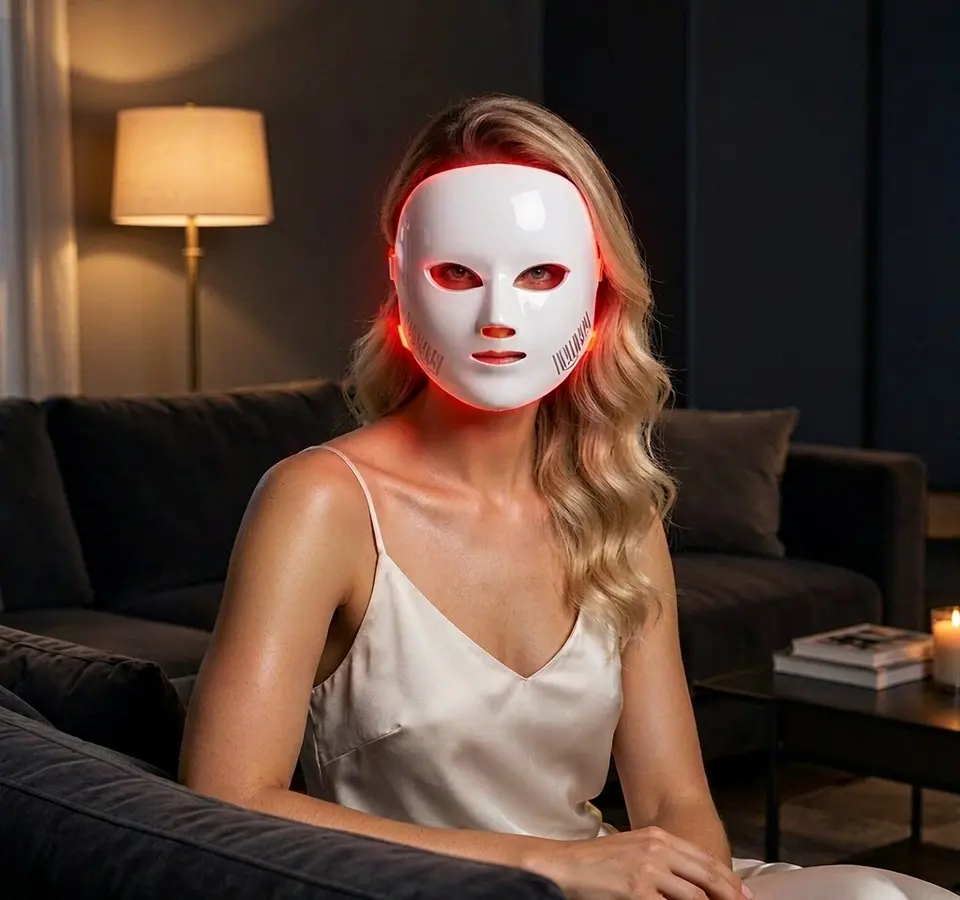
NEWKEY FDA-Cleared 4D Mask ($169.99) — 650nm red plus 465nm blue, cleared including an acne indication most premium masks on this list don't carry, 10-minute sessions with adjustable auto-off, 2-year warranty, 90-day money-back. Two honest concessions: it is not the deepest-penetrating mask in the category (we don't own an 830nm story), and it's wired rather than battery-powered — you're near an outlet during sessions. What it is, is the rational pick when acne and fine lines are both on the list and the $180–480 price gap matters. The wired design is a fair trade for many people: no battery to degrade, no charge-cycle fade in output, consistent power every session.
Which one is for you
| Your situation | Best fit | Why |
|---|---|---|
| Acne and fine lines, budget matters | NEWKEY 4D | Only mask here cleared for acne at under $200; blue + red in one device |
| Wrinkles only, comfort is decisive, price no object | Omnilux Contour Face | Best clinical pedigree, flexible fit, honest irradiance |
| Deepest possible NIR, dense coverage | CurrentBody Series 2 | 1072nm wavelength, 236 LEDs |
| You keep skipping long sessions | Dr. Dennis Gross Pro | 3-minute protocol you'll actually finish |
| Maximum coverage, spa-style ritual | TheraFace Mask | 648 LEDs, rigid full-face shell |
| Flexible fit under $350, wrinkles only | HigherDOSE | Same core wavelengths as Omnilux, lower tier |
Notice what the table doesn't contain: a mask that wins every row. That's the actual state of this market in 2026 — the premium masks are excellent, and the premium price buys depth, comfort, and brand polish, not a different category of results.
Five red flags that should end the conversation
- "FDA approved." No LED mask is approved; masks are cleared. A brand that doesn't know the difference doesn't know its own regulatory file.
- No wavelengths published. If you can't find a nanometer number on the product page, the dose you're buying is a rumor.
- Peak mW/cm² with no measurement distance. Output measured at 0cm and at 5cm differ by multiples. Any number without a distance is close to meaningless.
- "7 colors" as the headline feature. Color count is not dose. Most of the research-backed action lives in three bands: ~415nm, ~633–660nm, ~830–850nm.
- No stated return window. Results take 4–12 weeks of consistent use; a brand confident in its device gives you at least 30–90 days to find out.
Questions people actually ask before buying
Do LED face masks really do anything?
The wavelengths used by every serious mask on this list — 630–660nm red and 830–850nm near-infrared — have peer-reviewed support for stimulating collagen production and reducing inflammation, and blue light around 415nm has support for acne-causing bacteria. What the studies also show is that results are dose- and consistency-dependent: 3–5 sessions a week for 4–6 weeks is the protocol the research actually used, not occasional use whenever you remember.
Red light or blue light for acne?
They do different jobs. Blue (~415nm) targets C. acnes bacteria on the surface; red (~630–660nm) calms the inflammation and supports healing underneath. Our guide to how 465nm blue light works on acne covers the mechanism; the short answer is that if breakouts and marks are part of your problem, a mask with both wavelengths beats a red-only one.
Wired or cordless — does it matter?
More than marketing suggests, in both directions. Cordless masks are more comfortable and portable; wired masks never lose output to battery aging, never need a charge mid-protocol, and tend to cost less for the same light. If you'll use it in one room in front of a mirror, wired is a non-issue. If you want to walk around the house, it's a real limitation — buy accordingly.
Are LED masks safe for eyes?
With opaque eye protection and closed eyes, yes — and every mask on this list ships with some form of eye protection. The details (which wavelengths, what duration, which conditions warrant caution) are in our eye-safety guide. If you have any ocular condition or take photosensitizing medication, ask your doctor first.
Can I pay for one with HSA/FSA funds?
Possibly — LED devices can qualify when they address a diagnosed condition with proper documentation, including a Letter of Medical Necessity. The requirements and the two paperwork routes are laid out in our HSA/FSA guide.
The verdict in one paragraph
Buy the premium flexible mask if wrinkles are your only goal, comfort is decisive, and the price is a rounding error to you. Buy the CurrentBody Series 2 if you want the deepest wavelength money buys. Buy the Dr. Dennis Gross if your honest self-assessment is that you'll only finish 3-minute sessions. And buy the NEWKEY FDA-Cleared 4D Mask if you want FDA-cleared coverage of both acne and aging concerns at a price that leaves room for the serums you're supposed to wear underneath. Whichever you buy, buy it from a brand that publishes its wavelengths, its indications, and its warranty — because in this category, the brands that hide those three numbers are telling you something.
Ready to Transform Your Skin?
Explore our LED devices — the 4D mask is FDA-cleared — and start your clinical skincare journey today.
Shop Collection